
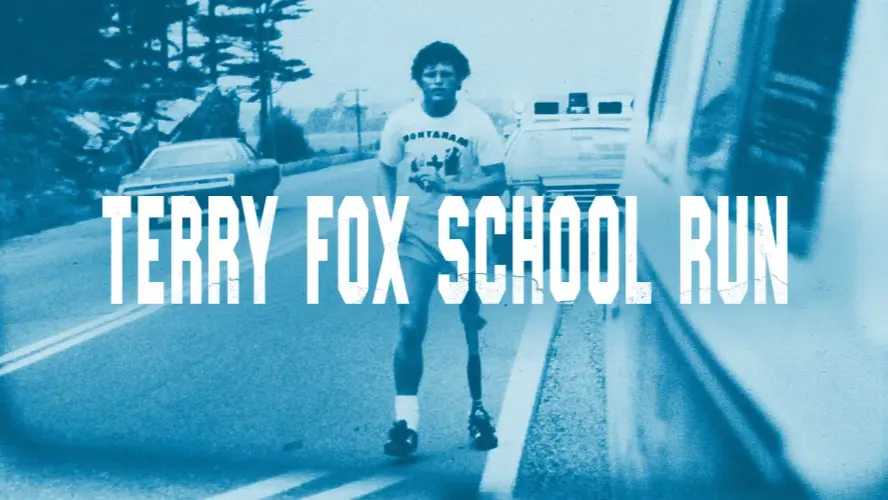
As the new academic year begins, so does something even bigger: the Terry Fox School Run is back! In just a few days, students across Central and Eastern Europe will lace up their shoes for a series of Marathons of Hope, with events taking place in seven cities this season. It is a moment we look forward to every year – not just for the running, but for what it represents: young people choosing compassion, perseverance, and action, and joining a movement that spans the globe. This year, we had the honor of speaking with Peter Sheremeta, International Run Director of Terry Fox Foundation, who shared his thoughts on Terry’s legacy and what it means to see it take root so far from home.
For readers in Central and Eastern Europe who may be discovering Terry Fox for the first time, who was Terry Fox, and why does his story continue to inspire people more than four decades later?
Terry Fox was an 18 year old Canadian student when he was diagnosed with osteogenic sarcoma (bone cancer) and forced to have his right leg amputated in order to halt the spread of the cancer. While in hospital, Terry was so overcome by the suffering of other cancer patients, many of them young children, that he decided to run across Canada to raise money for cancer research. He would call his journey the Marathon of Hope.
He would run 3,339 miles (5,373 km) in 143 days across Canada, averaging nearly a Marathon a Day, inspiring millions of people and raising millions of dollars for research. Terry had planned to run across the country, but he had to stop sooner than anticipated on September 1, 1980 as sadly the cancer had spread to his lungs. An entire nation was stunned and saddened. Terry passed away on June 28, 1981, at the age of 22. Although the heroic Canadian was gone, it was just the beginning of his legacy – a worldwide movement to eradicate cancer.
Millions of people around the world would raise funds for cancer research in The Terry Fox Run, showing that while cancer has no borders, neither does hope. People are inspired by how he gave all he could, pushing himself to his physical limits, and they are willing to take up his cause years later in the Terry Fox Run.
The Terry Fox Run has grown from a Canadian initiative into a global movement. What makes Terry’s story resonate across such different countries and cultures?
We all know someone who has had cancer – we all want our friends and loved ones to survive cancer. I think we all see something in Terry that we connect with – the act of trying our very best to overcome a challenge, and trying very hard to make a difference in an important cause.
The School Run is about much more than running or fundraising. What values do you hope children take away from participating?
The three top values I hope students can take away are:
Perseverance – never giving up.
Compassion – caring about others.
Activism – doing something to make this world a better place.
When children participate in a Terry Fox Run today, how are they becoming part of something much bigger than a single school event?
They are combining efforts with more than 3,000,000 other students around the world – all those millions of people raise a lot of money that funds a lot of cancer research. It is perhaps the largest charitable event in the world in terms of participants – students are part of a worldwide movement to cure cancer.
Cancer research has advanced enormously since Terry began his Marathon of Hope in 1980. How has the movement he inspired contributed to cancer research over the years?
It has attracted – and funded – many new scientists to the field of cancer research. It has unified teams of researchers and funded impacful research. One good example is in Terry Fox’s day, if you had bone cancer, 9 times out of 10 you would lose your leg. Today, 9 times out of 10 you keep your leg.
Why does continued public awareness and fundraising for cancer research remain so important today?
Because so many of our loved ones are still getting diagnosed with this disease. One friend of mine – she was a cancer survivor – told me “When you get that news from your doctor that you have cancer, you want the research done 10 years ago. That is why we need to fund cancer research now”.
You work with Terry Fox Runs around the world. Maple Bear schools are among the first schools in our region to organize Terry Fox School Runs in support of cancer research. Is there something about seeing this initiative now taking root in Central and Eastern Europe that has particularly impressed or moved you?
Yes, I see the shared humanity. The photos of your events show dedicated teachers, optimistic students, and caring parents – while these are photos thousands of kilometers away from Canada, in such places as Bulgaria, Poland, Czechia and Ukraine, they can be the same images as in Canada. Schools all have something in common – people who care about each other, people who believe that we can make the world a better place. While Terry was Canadian, he stood for hope, and that is universal.
If you could speak directly to the Maple Bear students preparing to take part in their Terry Fox School Run, what would you like to tell them?
They are heroes, just like Terry Fox! The money they are raising will fund research that may save the life of someone’s family members. I would also say thanks – what they are doing is amazing. Maple Bear is well known for giving back to the community – their students are showing that they are living up to that excellent reputation!
And finally, what do you think Terry himself would feel seeing thousands of children, many thousands of kilometres away from Canada, running today in his name and continuing his Marathon of Hope?
I think Terry would be honoured, especially with the fact that schools are doing this. Before he was diagnosed with cancer, Terry was a university student who wanted to become a physical education teacher. I think he would find it a fitting tribute that educators and students in Central and Eastern Europe are participating in such a large way in The Terry Fox Run.
